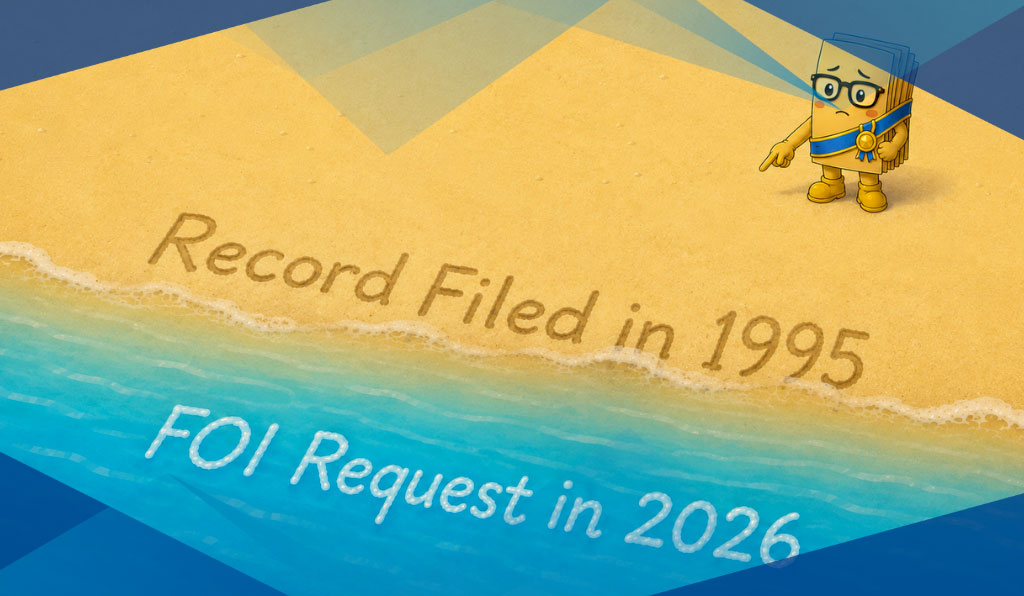
Physical records don’t alert you when they start to deteriorate
The challenge with paper degradation is that it builds slowly and invisibly, across years rather than weeks. Records sitting in a council storage room don’t communicate their condition.
Three common document types found in council storage carry the highest degradation risk:
- Inkjet prints: particularly vulnerable to heat, humidity fluctuations, and prolonged exposure to light
- Thermal fax paper: can fade completely without protection, sometimes within a decade depending on conditions
- Standard photocopies: more resilient, but still susceptible to moisture, foxing, and temperature fluctuations over time
These aren’t edge cases. They describe the storage conditions in which a proportion of council records currently sit: onsite rooms that weren’t built to archival standard, or records transferred from older facilities that predate any formal storage protocol.
The assumption that allows the risk of degradation to persist is that records in a box, in a room, with a label, are safe until they’re needed. The problem is that there is no way to know which records remain legible without retrieving and inspecting them. By the time a FOI request, audit, or legal matter requires a specific document, discovering the paper has degraded is not a position any records manager wants to be in.
The gap between retention requirements and physical reality
Victoria’s Public Record Office (PROV) sets retention periods under Retention and Disposal Authorities (RDAs). These are legal instruments that specify how long different record types must be kept. For local government, that can range from a few years for routine administrative records to permanent retention for records of ongoing legal significance.
PROV’s framework does include standards for the storage and preservation of records. However, the condition and longevity of physical records can still vary significantly depending on the document material, storage environment and required retention timeframe. As a result, records can sometimes be stored in ways that appear compliant, but may not be suitable for preserving readability over the full retention period. If a FOI request, audit, or legal matter calls for a document before it reaches its disposal date, a degraded record creates the same problem as a missing one.
Why ‘we’ll get to it later’ increases the risk
Digitisation and scanning are often treated as a future project, something to plan for when the budget is right, when there’s capacity, when the backlog has been sorted. In practice, later rarely arrives.
The longer the decision is deferred, the more the risk compounds:
- Records continue to age while remaining unreviewed and unactioned.
- Some will meet their retention period and become eligible for disposal, but remain in storage.
- Some will degrade past the point of usefulness while still technically within their retention window.
- The cost of digitisation increases over time. A record addressed early costs a fraction of what it costs to manage a decade later, when the backlog has grown and the physical condition of documents has become uncertain
In each case, the consequences are paid at the moment a record is needed, not at the moment the decision to defer was made. By the time a specific document is required, what condition it is in has already been determined by decisions made years earlier.
What proactive digitisation actually protects against
The most effective response to paper degradation isn’t a better storage room. It’s removing the dependency on paper altogether, before the condition of a document becomes a problem.
For councils holding records in onsite storage, proactive digitisation does three things at once.
- It creates a readable, searchable digital copy while the physical document is still in good condition.
- It removes the uncertainty about what a record will look like when it is eventually needed.
- And it positions the council to dispose of physical records in a PROV-compliant, audited way once the retention period is met, without the risk of discovering the paper has deteriorated in the meantime.
The records most worth prioritising are those with the longest retention, or stored in conditions that were never designed for long-term preservation. These are the records most likely to be needed at a point where their physical condition has already become a problem.
Compu-Stor works with Victorian councils across the full records lifecycle: secure storage, scheduled or on-request digitisation, metadata indexing aligned to your record-keeping system, and PROV-compliant disposal with certified destruction and a full audit trail. You don’t have to resolve the entire backlog at once. Starting with the records most exposed to degradation risk is the right place to begin.
How to prioritise your council’s digitisation program
The question for most councils isn’t whether to digitise, it’s where to start. With limited internal capacity and competing demands on the records management budget, every digitisation program needs a triage logic. Here is a practical framework for working out which records should be addressed first.
Step 1: Identify permanent retention records in vulnerable formats
Records with a permanent or lifetime retention requirement are the highest priority, regardless of their current format or condition. These records can never be destroyed. They must remain legible in perpetuity. If any of your permanent retention records exist in a degradation-prone format, the physical condition of the document is the only variable left to manage, and it is not improving over time.
Start by listing the record types your council holds that carry permanent or long-term retention requirements. Compu-Stor’s PROV RDA Finder can help you quickly confirm which of your record types fall into this category.
Step 2: Cross-reference format with retention window
Once you know which records carry long term or permanent retention requirements, map them against the three document types that carry the highest degradation risk: thermal fax paper, dye-based inkjet prints, and standard photocopies on acidic paper.
Thermal fax records from the 1990s and early 2000s are the most urgent. The National Archives of Australia notes that significant fading can begin in as little as five years even under optimum storage conditions[1]. For records from this period still held in onsite storage, the window to capture a legible copy may already be closing.
Step 3: Flag records approaching their disposal date
For records that are not on permanent retention, Compu-Stor’s PROV RDA Finder helps you identify which record types are approaching their authorised disposal date. Records within a few years of their disposal date that are held in poor storage conditions are strong candidates for early digitisation.
Step 4: Assess your storage conditions
Not all onsite storage carries the same degradation risk. A repurposed corridor cupboard and a purpose-built climate-controlled facility are not equivalent environments. If any of your records are held in rooms with significant temperature fluctuation, high humidity, or light exposure, those records move up the priority list regardless of their format.
A physical inspection is a reasonable starting point. The signs of degradation, like yellowing, mould, fading, brittleness, or moisture staining, are visible once you know what to look for A physical inspection also provides an opportunity to remove any hardware (like pins, staples or paper clips) or rubber bands which damage paper overtime.
Step 5: Start at the intersection of record material type, retention window, and storage conditions
The highest-priority records sit at the intersection of three factors: a permanent or long term retention window, a high-risk material type, and poor storage conditions. Records that meet all three should be treated as urgent. Records that meet two of three are still significant.
You do not need to resolve the entire backlog before starting. A triage approach allows you to work through the highest-risk records first, and is both practical and defensible as a records management strategy.
[1] National Archives Australia: Managing records on thermal papers

Compu-Stor’s PROV RDA Finder is a guided, interactive tool designed specifically for Victorian council records managers. Rather than downloading a schedule and working through the hierarchy manually, our Finder provides an interactive guide that allows you to manually click through Function, Activity and Class designations, or search based on a keyword.
For councils wanting to increase productivity, Compu-Stor provides a complete, PROV-compliant pathway from digitisation through to certified physical destruction, with full chain-of-custody documentation and a disposal certificate for your records. Get in touch to find out more.
The RDA Finder is designed to support retention decisions and should be used as a guide. For complex or edge-case record types, we recommend confirming the outcome with your Records Manager or contacting PROV directly.
This guide is intended as general guidance. For complex records or edge-case situations, we recommend confirming disposal decisions with your Records Manager or contacting PROV directly.
Get ahead of the problem before it becomes one
Compu-Stor’s full lifecycle records management service for Victorian councils covers every stage from intake through to certified destruction. If you’d like to understand how proactive digitisation could work for your council’s current holdings, we’re happy to walk through it.