What’s actually at risk from retrieval delays
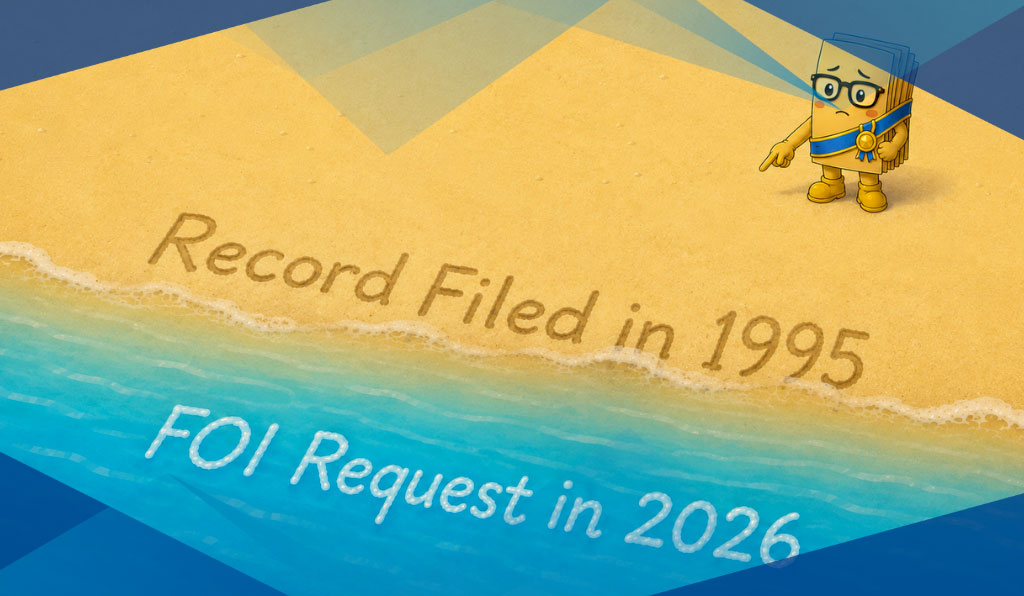
The 30-day response window under the Freedom of Information Act 1982 can feel manageable in isolation. A physical retrieval takes two or three days. That leaves well over three weeks to prepare the response. On paper, there is time.
In practice, records managers are rarely handling one request at a time. Multiple FOI requests land concurrently, each with their own deadlines and each requiring its own retrieval, review, and prepared response. Competing priorities, such as other compliance obligations or resourcing constraints, compress the available time further. A response that seemed comfortably within reach starts to slip.
By the time everything else has been accounted for, the window has narrowed. And when the retrieval takes two or three days to arrive, that wait is not necessarily the cause of a late response — it is often the factor that tips an already-stretched timeline past the deadline.
Besides the obvious financial cost of retrievals, the more damaging consequence is what happens at that tipping point. In its Own Motion Investigation Report into Impediments to Timely FOI and Information Release¹, the Office of the Victorian Information Commissioner found that delays effectively deprived FOI applicants of their rights, and equated a delayed response to the same practical outcome as an outright refusal.
A delayed FOI carries consequences not just for the applicant who loses access to their rights, but also for the agency whose failure to respond becomes a matter of public record.
Victoria Police FOI delays
.
Victoria Police's FOI delays have drawn media coverage, and resulted in the force ranking as the Victorian agency with the most escalations to OVIC in 2024-25.
.
Persistent retrieval delays have a way of becoming public record, regardless of whether the organisation intended them to.
The gap between retention requirements and physical reality
Victoria’s Public Record Office (PROV) sets retention periods under Retention and Disposal Authorities (RDAs). These are legal instruments that specify how long different record types must be kept. For local government, that can range from a few years for routine administrative records to permanent retention for records of ongoing legal significance.
PROV’s framework does include standards for the storage and preservation of records. However, the condition and longevity of physical records can still vary significantly depending on the document material, storage environment and required retention timeframe. As a result, records can sometimes be stored in ways that appear compliant, but may not be suitable for preserving readability over the full retention period. If a FOI request, audit, or legal matter calls for a document before it reaches its disposal date, a degraded record creates the same problem as a missing one.
The assumption that slows things down
A lot of retrieval friction comes from an acceptance that physical records take time, and that is simply the nature of managing archives. Waiting two or three days for a box to arrive feels normal when it has always been that way. But it does not have to be.
A digitised record, properly tagged with metadata and loaded into an organisation’s digital records environment, does not require a request to a warehouse, waiting for a courier, collating a physical file, or scanning documents before they can be shared. It is searchable in seconds, accessible by the right people immediately, and available whether staff are in the office or working remotely.
The difference runs deeper than an efficiency improvement. For government agencies managing FOI obligations, ministerial requests, legal matters, and governance reviews, the difference between hours and days is a meaningful operational shift.
Physical Records Retrieval vs. Digital Records Access: What the Difference Looks Like in Practice
| Physical Retrieval | Digitised Record | |
|---|---|---|
| Access time | 1-3+ business days | Seconds |
| Staff effort | High - requesting, chasing, collating, scanning | Minimal - search and retrieve |
| Remote access | Not possible | Available from anywhere |
| FOI response risk | High - delays can become a governance issue | Low - records available on demand |
| Failed retrieval risk | Present - poor indexing, wrong box, incomplete | Near zero with proper metadata tagging |
The compounding effect of volume
Retrieval delays do not stay constant. As archives grow, the pressure on retrieval processes grows with them. Records accumulate across departments and sources. Some are properly indexed; others are not. Some are held offsite with one provider; others sit in a different location or format entirely.
When a request comes in, the complexity of locating the right record increases proportionally with the volume of what is in storage. A public sector organisation managing fifteen semi-trailer loads of archival boxes (with no clear picture of what is in them) faces a retrieval challenge that is qualitatively different from one with a well-indexed, digitised archive.
And the staff time rifling through an unorganised archive is staff time not spent on higher value work.
A clearer path
For agencies that have already stood up their own digital records environment, Compu-Stor digitises physical records with structured metadata and integrates directly with the systems your team already uses, including Objective, Microsoft SharePoint, and OpenText Content Manager. Records become searchable within your existing environment, without a new platform or a parallel workflow.
For agencies that are not yet in a position to stand up a full EDRMS, the Complete Information Management System (CIMS) is built to be the practical first step. Records are digitised to PROV-compliant standards, metadata is mapped and structured, and your team gets immediate searchable access through the CIMS portal, without waiting for a full internal system to be ready. When your agency does move to its own platform, the metadata structure is already in place for migration.
For records that still need to be held physically, CIMS gives agencies a real-time view of what is in storage, where it is, and when it is due for review or disposal. Retrieval requests that do go ahead are tracked from pickup to return, with full chain of custody throughout.
The aim is straightforward: when someone needs a file, they can find it quickly, reliably, and without a process that takes days and pulls multiple team members off other work.
If retrieval delays are a regular part of your records workflow, we can show you what a quicker approach could look like for your organisation. Talk to the Compu-Stor team.
Sources
- Office of the Victorian Information Commissioner, Own Motion Investigation Report: Impediments to Timely FOI and Information Release, tabled in the Victorian Parliament, September 2021.
- IDM Magazine, Frozen in COVID: Victoria Police’s 9-month FOI delays, April 2026.
- Policing Insight, Victoria Police Freedom of Information response delays at all-time high, 2026.

Compu-Stor’s PROV RDA Finder is a guided, interactive tool designed specifically for Victorian council records managers. Rather than downloading a schedule and working through the hierarchy manually, our Finder provides an interactive guide that allows you to manually click through Function, Activity and Class designations, or search based on a keyword.
For councils wanting to increase productivity, Compu-Stor provides a complete, PROV-compliant pathway from digitisation through to certified physical destruction, with full chain-of-custody documentation and a disposal certificate for your records. Get in touch to find out more.
The RDA Finder is designed to support retention decisions and should be used as a guide. For complex or edge-case record types, we recommend confirming the outcome with your Records Manager or contacting PROV directly.
This guide is intended as general guidance. For complex records or edge-case situations, we recommend confirming disposal decisions with your Records Manager or contacting PROV directly.