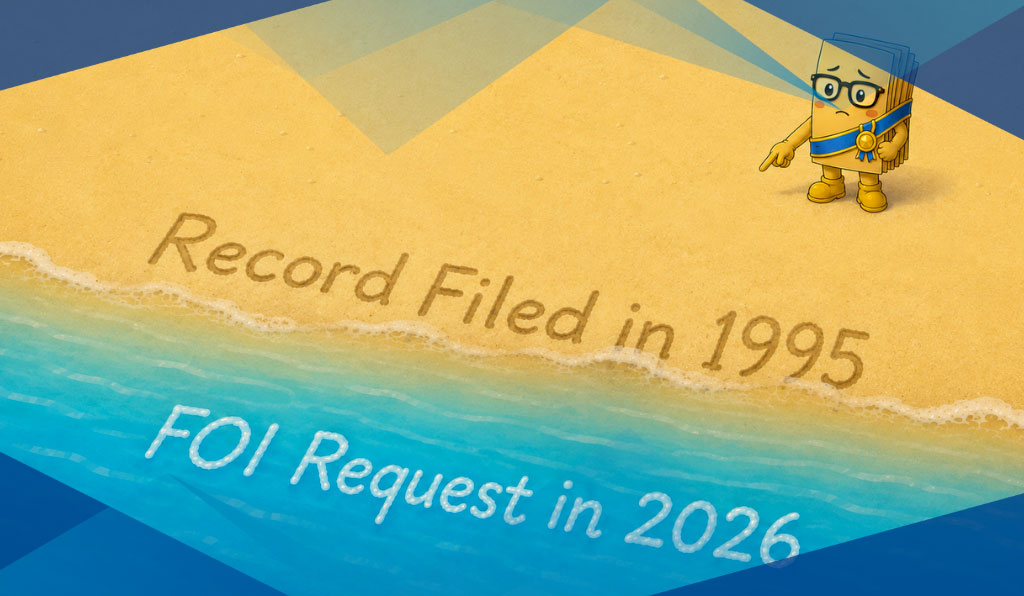
Nobody intended to destroy it. But without a clear picture of what was in storage and which records were genuinely eligible for disposal, it was destroyed anyway. It's a moment every records manager dreads, and as you're about to see, it's also one with a clear, well-trodden path back.
Early record destruction: it’s less likely than you fear, and more recoverable than you think
Wrongful destruction is one of the more unsettling scenarios in records management, largely because it feels irreversible the instant it’s discovered. In practice, most government agencies never encounter it, and where it does happen, there’s a genuine, well-established path to putting it right.
The fear of early destruction shouldn’t put you off a properly managed disposal process. PROV’s disposal authorities exist precisely so records can be destroyed with confidence once they’re genuinely eligible, and holding onto everything indefinitely isn’t a safer strategy either. It creates its own well-documented costs.
Why an early destruction happens
Nobody sits down and decides to destroy a record that isn’t eligible. It happens in the blind spot between what a retention schedule says a box should contain and what’s actually inside it.
Here’s a common version of it. A retention register confirms a document exists somewhere within a particular storage transfer, but not exactly which box it’s in. When that transfer comes up for review, a box gets sentenced for destruction based on the record type it’s expected to hold. What the sentencing doesn’t catch is a single document filed in that box in error some years earlier, one that belongs to a different function entirely, with a longer retention period still running. Because the box is actioned as a whole rather than record by record, that misplaced document is destroyed along with everything else in it.
It’s a plausible scenario once you account for the sheer volume of legacy records most government agencies are currently holding. One council records manager told us they estimate they have around 15 shipping containers’ worth of documents in storage. With volumes like that, and records teams already stretched across higher-priority work, reconciling the retention register against the actual physical holdings is typically the task that gets deprioritised. It’s not a failure of care. It’s a records holdings visibility gap that most retention schedules managed in-house, however carefully built, can’t fully close on their own, because a schedule can only describe what a box should contain, not confirm what it actually does. It’s one of the key limitations of a spreadsheet-managed retention schedule — the structure can be sound and still not account for what’s physically inside a box.
The regulatory landscape governing disposal
A handful of Victorian laws intersect at the point of destruction, and it’s worth understanding how they fit together.
- Section 19 of the Public Records Act 1973 makes unlawful destruction of a public record an offence. The Act doesn’t distinguish between deliberate destruction and destruction that results from an unverified retention period, which is exactly why finding the right PROV Retention and Disposal Authority and confirming the disposal trigger before acting matters so much (more on that below).
- Section 254 of the Crimes Act 1958 (inserted by the Crimes (Document Destruction) Act 2006) creates a separate offence where a document is destroyed with the intention of preventing its use in legal proceedings. This one is about intent. A genuine process error, properly documented and disclosed, sits in a different category to a deliberate act.
- FOI obligations survive the destruction of the record. If a document is requested under the Freedom of Information Act 1982 and has already been destroyed, the agency still needs to account for it, with the supporting documentation of what happened and why.
- PROV’s role here is oversight, not punishment. The Keeper of Public Records can review disposal decisions and ask an agency to account for what occurred. That’s a fact-finding function, and agencies that engage with it openly, with a clear remediation plan, are in a materially different position to those that don’t.
The authorisation process exists to make disposal decisions defensible, whether they’re being reviewed as routine practice or scrutinised after something’s gone wrong.
If it does happen: the steps that put things right
A wrongful destruction, caught early and handled well, is a solvable problem. Here’s the practical sequence.
- Document what happened as soon as it’s identified. Record what was destroyed, when, who identified the issue, and what retention period and trigger should have applied. This documentation is what separates a defensible response from an indefensible one, and starting it immediately shows a good-faith effort to correct an error transparently.
- Check for a surviving copy before assuming the record is gone. A meaningful number of “destroyed” records still exist somewhere: a digitised scan taken before physical destruction, a duplicate held in another business unit, an email attachment, or a copy already transferred to PROV. This step alone can resolve the incident before any further action is needed.
- Escalate internally through your agency’s usual channels. Bring in your records manager, legal or governance team, and where relevant, the head of the public office, who carries statutory responsibility for the agency’s recordkeeping program under section 13B of the Public Records Act 1973. This isn’t about assigning blame. It’s about making sure the right people can support a proper response.
- Engage with PROV proactively rather than waiting to be asked. The Keeper’s role is to help agencies get their recordkeeping right, not to catch them out. An agency that identifies its own error, documents it clearly, and brings a remediation plan is in a fundamentally stronger position than one whose gap is discovered later without any of that groundwork done.
- Put a documented fix in place, and keep the record of it. Whether that’s correcting a retention schedule entry, tightening a sign-off step, or reviewing how a specific batch of boxes was sentenced, the fix itself becomes part of the evidence that the agency took the issue seriously and closed the gap.
The four steps that keep this from happening in the first place
Prevention is still the better outcome, and it comes down to the same four things that make a disposal decision defensible on review.
- Identify the correct RDA and confirm it covers the record type. For Victorian councils, this is typically PROS 09/05 (Retention and Disposal Authority for Local Government Functions), with PROS 07/01 (Common Administrative Functions) covering administrative records common to most public offices. The RDA needs to specifically authorise destruction of that class of record, not just cover a generally similar one. If you’re not sure which RDA applies to a given record type, Compu-Stor’s PROV RDA Finder can help you confirm it in under a minute.
- Confirm the retention trigger has been met, not just the retention period. This is where disposal triggers and retention periods most often diverge in practice. A record held for seven years isn’t necessarily eligible if the trigger is seven years from matter closure rather than seven years from creation.
- Obtain internal written authorisation before destruction proceeds. PROV’s Disposal Standard (PROS 22/04) requires this in addition to the RDA itself, in practice a signed Destruction of Records Authorisation form approved by the manager of the relevant business unit, confirming no legal, audit or FOI hold applies.
- Issue a Certificate of Destruction and file it. A Certificate of Destruction documents what was destroyed, when, by whom, under which RDA, with confirmation that the trigger was met and authorisation obtained. It’s frequently the piece that’s missing when a decision is later questioned, and the one that makes a decision defensible when it’s produced.
PROV publishes its own destruction checklist covering the same ground, and it’s a useful sense-check to run before and after any destruction activity:
| Before destruction | After destruction |
|---|---|
| Authorised for destruction under a current RDA, SIDA, or Normal Administrative Practice | Certificate of destruction produced |
| Confirmed no longer in active use | Appropriate destruction method used |
| Confirmed not subject to current or pending litigation, an FOI request, or a disposal freeze | |
| Internal authorisation obtained and documented | |
| Security requirements identified, with an appropriate destruction method selected if needed |
Clear visibility into your records backlog helps prevent early disposal
There’s a narrow window in which a record can be confidently destroyed: once its retention trigger has genuinely been met, but before it’s sitting in storage untouched for years, waiting on a review that keeps getting pushed back. What most often gets in the way of acting inside that window isn’t a lack of will, it’s simply the volume of records in storage and limited visibility into exactly what’s inside any given box — particularly for records stored in conditions that were never designed for long-term preservation.
Closing that gap comes down to having a single, reliable picture of what’s in storage, what’s been sentenced against which RDA, and which triggers have actually been confirmed rather than assumed, especially where records have moved between departments or predate the current retention schedule — a scenario explored in detail in our guide to how retention schedules break down over time.
This is where a structured system genuinely helps, in prevention and in recourse. In Compu-Stor’s CIMS portal, every disposal request is logged against the specific RDA and trigger, requires named sign-off before it proceeds, and generates a Certificate of Destruction automatically as part of the record. If a question ever does come up about a specific batch, that documentation already exists rather than needing to be reconstructed. And because Compu-Stor digitises records as part of the broader lifecycle service, there’s frequently a surviving digital copy even where a physical original has been destroyed, which is often the fastest way to resolve an incident cleanly.
For records that haven’t yet been indexed or sentenced, Compu-Stor can also sort through boxes, index documents, and confirm the correct RDA and trigger against your holdings directly, closing the visibility gap before a disposal decision is made rather than after.
Talk to a team that manages this every day
Whether you’re building a defensible disposal process from scratch or working through an incident that’s already happened, you don’t have to figure it out alone. Compu-Stor supports Victorian government agencies across the full records lifecycle, from storage and indexing through to PROV-compliant disposal with a full audit trail, addressing the compounding cost of over-retained records at every stage.
See how Compu-Stor supports Victorian government agencies →
This guide is intended as general guidance. For complex records, edge-case situations, or if you’re currently working through a specific incident, we recommend confirming next steps with your Records Manager or contacting PROV directly.

Compu-Stor’s PROV RDA Finder is a guided, interactive tool designed specifically for Victorian government records managers. Rather than downloading a schedule and working through the hierarchy manually, our Finder provides an interactive guide that allows you to manually click through Function, Activity and Class designations, or search based on a keyword.
For government orginisations wanting to increase productivity, Compu-Stor provides a complete, PROV-compliant pathway from digitisation through to certified physical destruction, with full chain-of-custody documentation and a disposal certificate for your records. Get in touch to find out more.
The RDA Finder is designed to support retention decisions and should be used as a guide. For complex or edge-case record types, we recommend confirming the outcome with your Records Manager or contacting PROV directly.
This guide is intended as general guidance. For complex records or edge-case situations, we recommend confirming disposal decisions with your Records Manager or contacting PROV directly.